 Fort Collins Gas Fireplace Repair
 Gas Fireplace Repair in Fort Collins
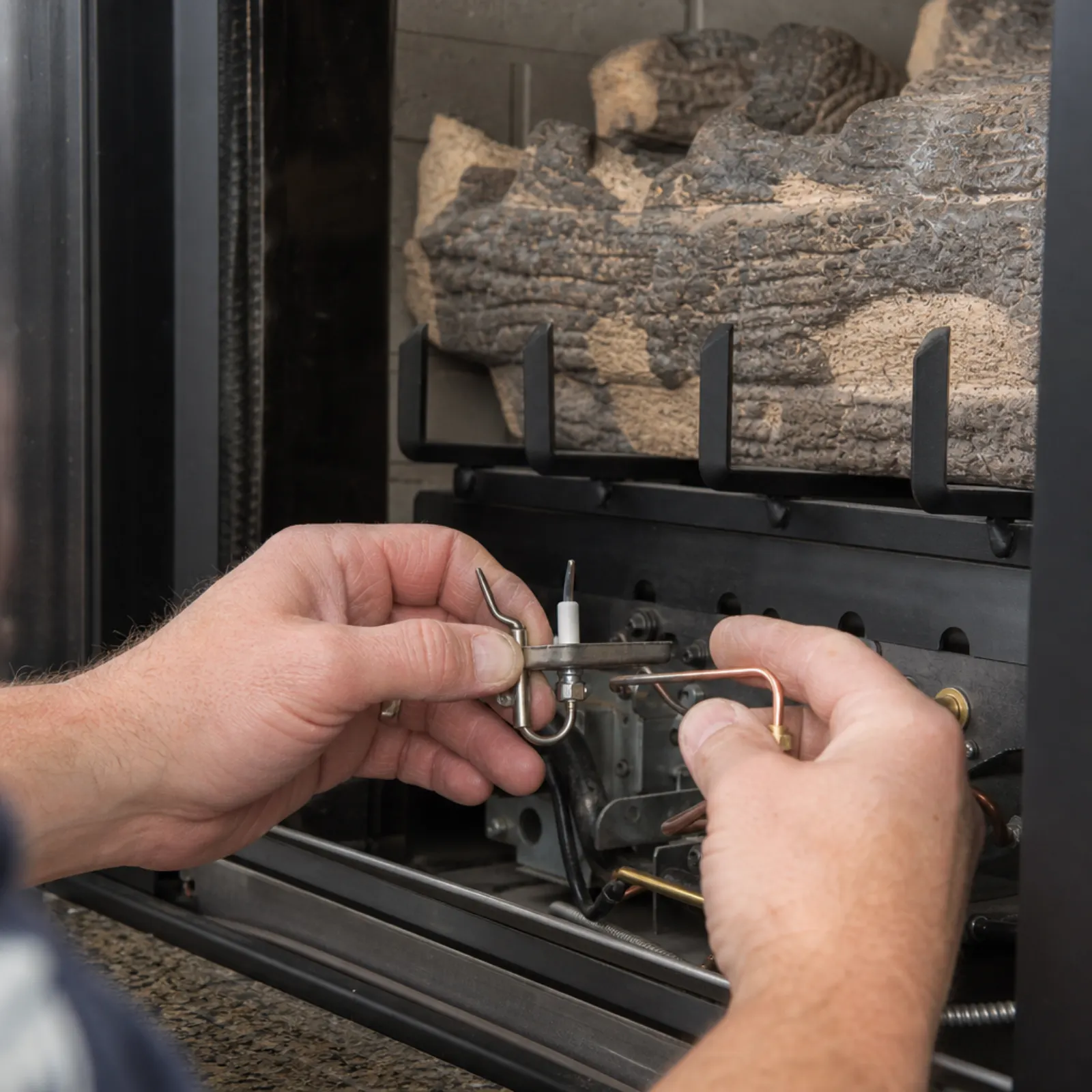
Gas fireplace repair in Fort Collins starts with a $150 to $300 diagnostic service call, and most common fixes land between $200 and $600 installed on the same visit: a thermocouple or thermopile, a pilot assembly, a remote receiver, a blower. A gas valve runs $500 to $1,000. Send the model number from the rating plate inside the bottom louver and the symptom, and you get a real number and a technician who knows which parts to bring.
If you smell gas, close this page, leave the house, and call Xcel Energy or 911 from outside. Everything below is for a fireplace that is safe but not working.
Common symptoms in Fort Collins, and what they usually mean
Nothing happens at the switch. Standing pilot out, dead thermopile, a wall switch or remote that failed, or on an electronic unit, dead backup batteries or a tripped gas valve at the wall. Check the batteries in both the remote and the receiver before you call anyone; it solves a real share of these.
Pilot lights but will not stay lit. The thermocouple is not holding the safety magnet open. Weak thermocouple, or a pilot flame too lazy to heat it because the pilot hood is packed with a summer’s dust. This is the October call. The pilot and ignition page covers it in detail.
Pilot is lit but the burner will not come on. Thermopile below the 300 to 750 millivolts it should generate, or a switch, wire, or valve problem downstream. Measured in seconds with a meter.
Clicks, no flame. Electronic ignition sparking without proving a pilot. Batteries, gas supply, spark electrode, pilot orifice, module, in that order.
Lights, then drops out. Flame sensing rod on an IPI unit, a sagging thermopile on a millivolt unit, or a thermostat or remote cycling.
Lazy yellow flame, soot on the glass and logs. The fireplace is running rich. In Fort Collins that is one of four things: logs sitting on the burner ports, a closed air shutter, high manifold pressure, or an orifice that was never derated for 4,997 feet. See the altitude section below.
Whistling or roaring. A whistle is usually the pilot hood or a partially closed valve. A roar is a pressure problem or a burner running without its logs and embers in place.
Smell of gas. Leave and call the utility. Then it is a leak at a flare fitting, a failed valve seal, or a cracked pilot tube.
Fogging, white haze, or a smell of burning dust on first fire. Normal. White haze is combustion deposit; it comes off with ceramic-glass cleaner on cold glass, never with a household ammonia cleaner. The burning-dust smell on the first fire of October is the dust on the burner and the blower, and it clears in an hour.
Altitude is a real fault here
Fort Collins sits at 4,997 feet. The National Fuel Gas Code (NFPA 54 / ANSI Z223.1) calls for derating gas appliances installed above 2,000 feet by about 4 percent per 1,000 feet, and manufacturers publish high-altitude orifices and conversion kits by elevation band, with natural-gas kits typically starting above 4,500 feet. The installer is responsible for the adjustment. A fireplace that came out of a warehouse set for sea level, or a replacement valve or burner installed without the altitude kit, runs rich: the same orifice pushes the same gas into thinner air. You see it as yellow, lazy flames, soot, delayed ignition with a whump, and higher CO. Ask that every repair include an orifice size and manifold pressure check in inches of water column, because a clean burner with the wrong orifice will soot again in a week.
Up the Big Thompson Canyon in Estes Park at 7,743 feet the derate is well over 20 percent, and propane cabins add a second variable, so nothing runs right there without the correct kit.
What is behind the louver in a Fort Collins home
The housing era tells a tech what they are walking into:
- Old Town and the 1970s ring. Old Town’s National Register district was listed in 1978 for its 1880s to 1905 commercial blocks, and the residential streets around it, and the 1960s and 1970s subdivisions that followed, carry masonry fireplaces. Most of those were fitted later with gas log sets on a standing pilot and a manual valve. The failures are pilot assemblies, thermocouples, corroded burner pans, and dampers that will not stay open.
- South Fort Collins, the Harmony corridor, Fossil Creek. The city’s rapid southward expansion in the late 20th century was built with factory direct-vent fireplaces as standard equipment, sealed glass and a coaxial vent through the wall. Those units are now 20 to 30 years old, on their original thermopile, gasket, and blower. This is where most thermopile, blower, and gasket work in town comes from.
- Timnath, Wellington, Windsor’s newer phases. Electronic intermittent pilot with a battery backup and a remote. Failures are modules, flame-sense rods, receivers, and dead batteries.
How the repair visit goes
- Triage by message. Model number, symptom, standing pilot or electronic. This is what makes it a one-visit job.
- Safety. Combustible gas detector at the valve, fittings, and firebox. CO reading. Vent termination and clearances checked. A fireplace that fails here stays off until it is fixed.
- Diagnose with instruments. Pilot flame quality. Thermocouple and thermopile output in millivolts. Spark and flame-sense on electronic units. Wall switch and receiver. Inlet and manifold gas pressure. Orifice size against the elevation.
- Clean. Burner ports, pilot assembly, logs (vacuumed, not washed), glass, blower cage. Half of the “weak flame” calls end here.
- Replace what failed. Pilot assembly, thermocouple or thermopile, valve, module, remote, blower, gasket, glass.
- Test-fire and document. Verify ignition and shutdown, set the logs and embers for a proper flame, and leave you the readings.
What it costs
| Repair | Range |
|---|---|
| Diagnostic service call | $150 to $300 |
| Thermocouple or thermopile | $200 to $400 |
| Pilot assembly | $300 to $600 |
| IPI module | $350 to $700 |
| Gas valve | $500 to $1,000 |
| Remote receiver or wall switch | $150 to $400 |
| Blower | $250 to $600 |
| Glass and gasket | $200 to $600 |
Brand and ignition type set the parts price; the rating plate photo turns the range into a number. The pricing page has the full table, the repair cost estimator will put a range on your symptom in about twenty seconds, and the problems pages go symptom by symptom through what is usually behind each one. If the honest diagnosis is that the valve, the firebox, and the vent are all failing on a 30-year-old unit, the insert installation page is the honest next stop rather than three repairs in a row.
The gas line, shutoff valve and flex connector
The last few feet before a gas fireplace are the house piping, a shutoff valve, and a connector to the fireplace’s control valve. The rules are the Colorado Fuel Gas Code: the 2021 International Fuel Gas Code as adopted by the State Plumbing Board in 3 CCR 720-1.
The shutoff valve. Every appliance needs its own. Section 409.5.1 puts it in the same room as the appliance, within 6 feet of it, upstream of the connector, and with access. A shutoff inside the firebox has to be installed the way the fireplace manufacturer’s instructions say. For decorative appliances in vented fireplaces, section 409.5.2 also allows a shutoff in a remote spot with ready access, as long as it is permanently identified and serves no other appliance.
The flex connector. An appliance connector may be no more than 6 feet long, one per appliance (411.1.3.1), and may not be concealed in or run through a wall, floor, partition or ceiling (411.1.3.3). A fireplace insert that comes from the factory with a grommet or sleeve for that purpose under its listing is an exception. A connector that vanishes into a wall, or no shutoff near the fireplace, is worth mentioning when you book.
Signs of a gas line problem. Xcel Energy, the gas utility here, lists a rotten-egg smell and a sound from a slight hiss to a loud roar; a very small leak may make no sound. Its guidance is to leave, use nothing that can make a spark, and once safely away call 911 and then Xcel at 1-800-895-2999. A shutoff that will not turn by hand is not one to force.
Who may do the piping. Under C.R.S. 12-155-120, a permit has to be taken out before any gas piping installation, and only a qualified applicant may apply: a licensed master plumber who is a registered plumbing contractor or works for one, or a homeowner working on their own home. Board rule 1.6 requires inspections for all fuel gas piping work, including a final inspection of the appliance shutoffs. Ask who will pull the permit, and ask to see the license and registration behind it.
Who does the work
Gas piping is regulated by the State Plumbing Board, whose rules require a permit and inspection for all fuel gas piping work; appliance work is licensed locally, and Fort Collins issues a Fireplace Appliance trade license through Building Services for exactly this work. A like-for-like part repair does not need a permit. New piping or a new appliance does, and the contractor doing the work should pull it; ask to see the permit and the Fireplace Appliance license.
Repair requests are taken across Fort Collins and out to Loveland, Windsor, Timnath, Wellington, Greeley, and Estes Park. Send the rating plate and the symptom, and check the batteries first; that is the fix more often than people expect.
Frequently Asked Questions
What does a gas fireplace repair visit cost in Fort Collins?
The diagnostic service call is $150 to $300 for the first hour and includes the gas detector, CO meter, manometer, and millivolt readings. If the fix is a common part, it usually happens on the same visit: thermocouple or thermopile $200 to $400, pilot assembly $300 to $600, ignition module $350 to $700, gas valve $500 to $1,000. Many techs credit the diagnostic fee to the repair; ask when you book.
Can you fix it on the first visit?
Most of the time, if you send the model number from the rating plate first. Our techs commonly carry thermocouples, thermopiles, pilot assemblies, and common valves. Brand-specific parts such as ceramic glass, a particular IPI module, or a remote receiver may need to be ordered, and you get told that before the visit, not after.
Why does my fireplace run for a few minutes and then shut off?
On a standing-pilot unit that is a thermopile that starts strong and sags as it heats, a valve that is marginal, or a thermostat or remote cycling it off. On an electronic unit it is usually the flame sensing rod losing the flame. Either way it is a reading on a meter, not a guess, and it is a $200 to $700 range depending on which part.
Is a lazy yellow flame dangerous?
It is a warning. A gas fireplace should burn a mostly blue flame with yellow tips on the logs. Fully yellow, lazy, or sooting flames mean incomplete combustion, which produces more carbon monoxide. On a sealed direct-vent unit the exhaust goes outside, but on a vent-free log set or a B-vent unit it can end up in the room. Stop using it and get it looked at.
What if I smell gas around the fireplace?
Leave the house, leave the door open, do not touch any switches, and call Xcel Energy's gas emergency line or 911 from outside. A gas smell is the utility's emergency first. Once the house is cleared, the leak gets traced with a combustible gas detector at the valve, the flare fittings, and the pilot tubing, and fixed.
Where should the gas shutoff for my fireplace be, and how long can the flex line be?
Under the Colorado Fuel Gas Code (the 2021 International Fuel Gas Code as adopted by the State Plumbing Board), each appliance gets its own shutoff valve in the same room, within 6 feet of the fireplace, upstream of the connector, and with access. A decorative appliance in a vented fireplace may instead have a remote shutoff with ready access if it is permanently identified and serves nothing else. The connector may be no more than 6 feet long and may not run through a wall, floor or ceiling, except for an insert factory-fitted with a grommet or sleeve under its listing. New gas piping needs a permit taken out by a licensed master plumber who is or works for a registered plumbing contractor, or by a homeowner on their own home, so ask who will pull it.
More fireplace services
Areas we serve
- Fort Collins, CO
- Gas Fireplace Repair in Berthoud, Colorado
- Gas Fireplace Repair in Estes Park, Colorado
- Gas Fireplace Repair in Greeley, Colorado
- Gas Fireplace Repair in Johnstown, Colorado
- Gas Fireplace Repair in Laporte, Colorado
- Gas Fireplace Repair in Loveland, Colorado
- Gas Fireplace Repair in Milliken, Colorado
- Gas Fireplace Repair in Severance, Colorado
- Gas Fireplace Repair in Timnath, Colorado
- Gas Fireplace Repair in Wellington, Colorado
- Gas Fireplace Repair in Windsor, Colorado